The Digital Pirate: Why Cyber Attacks Are the New "Danger Zone" at Sea
The maritime industry faces a clear and present danger as ships become prime targets for cyberattacks that can cripple operations, endanger safety, and disrupt global trade.

The Cost of Inaction: Real-Life Incidents and Crushing Financial Impact
Cyber incidents in the shipping industry follow a pattern of low frequency, but exceptionally high impact. The consequences extend far beyond a single ship, threatening global supply chains and causing financial fallout in the hundreds of millions.
The Maersk Case (2017): The NotPetya malware attack delivered one of the most severe shocks to the industry, disrupting operations across the major shipping company globally. The fallout resulted in an estimated $300 million in losses for the company and contributed to an estimated $8.4 billion in direct economic damage for all stakeholders.
COSCO Ransomware Attack (2018): COSCO Shipping Lines were hit by a ransoomware attack targetting its U.S. operations, forcing the shut down of its email systems and IT network across their US operations. Online bookings, customer service communications and logistics planning were paralyzed for weeks.
Whilst the maritime sector quickly digitalised, many companies did not keep up in their cybersecurity. Criminals thus view shipping as an "easy target" with increasingly higher rewards. A 2023 study found that the average cost of a maritime cyber attack reached $550,000. Ransom demands themselves have dramatically increased, with the average ransom payment reaching $3.2 million. The financial losses are driven by operational downtime, cargo theft, and the cost of recovery and remediation.
When systems are compromised, the operational risk is profound. Attackers can disrupt cargo management, compromise safety-critical navigation and communication systems, or even take control of propulsion and machinery, threatening the vessel and crew’s safety.
The Expanding Cyber Threat Landscape
Modern ships rely on tightly interconnected IT and OT systems for navigation (GPS, radar, VINS), propulsion, cargo management, and communications. Weak security, obsolete software, and poor access controls have created digital cracks in the hull.
Types of Cyber Threats Facing Ships:
Phishing/Spear-phishing: Deceptive emails tricking crew into exposing credentials or installing malware.
Malware/Ransomware: Locks or corrupts ship systems, often demanding payment to restore access.
Denial-of-Service (DoS/DDoS): Overloads ship networks, halting operations.
GPS Spoofing: Manipulates navigation systems, redirecting or endangering vessels.
Insider Threats: Crew or third-party negligence—or deliberate sabotage.
Data Breaches: Theft of cargo, crew, or passenger data, creating secondary risks for security and compliance.
Lessons Learned: The Digital Cracks in the Hull

Highlighted Vulnerabilities
Human Error and Poor Cyber-Hygiene: This is consistently the weakest link. Incidents are often caused by poor risk awareness and a failure to spot phishing scams. Worryingly, 60% of malware cases on vessels are spread through basic means like infected USBs and removable media.
Unprotected IT/OT Convergence: The blurring lines between shore-based IT and vessel-based Operational Technology (OT)—which controls systems like propulsion and ballast—leaves critical systems exposed. These interconnected systems often lack proper network segmentation.
Obsolete Systems: Many ships operate with outdated, obsolete operating systems and software that can no longer receive updates or adequate anti-malware protection, leaving an open door for modern threats.
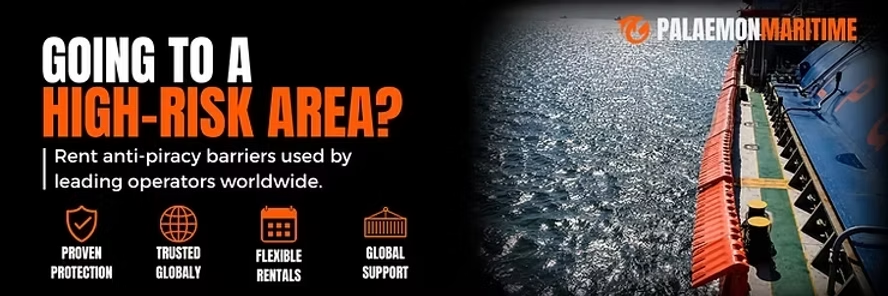
GOING TO THE HIGH-RISK AREA?
Join the largest Oil Majors, and rent anti-piracy barriers with Palaemon:
See the cost of renting anti-piracy barriers.
Improving Cyber Resilience: Risk-Mitigation Strategies
Crew Training & Awareness
Regular, maritime-specific training on phishing recognition, password hygiene, and USB/device controls.
Incident response drills to eliminate hesitation when attacks occur.
Robust Systems & Segmentation
Isolate OT systems from IT networks and public internet access.
Strong access control, multi-factor authentication, and endpoint protection across all systems.
Incident Response Preparedness
A detailed cyber incident response plan for rapid containment and recovery.
24/7 monitoring through a dedicated Security Operations Centre (SOC) or managed detection and response system.
Supply Chain Security
Vetting digital interfaces with ports, logistics providers, and remote management services.
Strict IoT/device management policies to prevent unauthorized devices from plugging into critical systems.
Beyond Compliance: The IMO and the New Baseline
IMO Resolution MSC.428(98) mandated that Administrations ensure cyber risks are appropriately addressed in existing Safety Management Systems (SMS) under the ISM Code by the first annual verification of a company's Document of Compliance after January 1, 2021.
However, compliance is only the baseline. A truly secure operation requires going beyond the IMO's high-level recommendations, here are some ways to do that:
IACS Unified Requirements (UR E26/E27): These standards set a more stringent, mandatory baseline for the cyber resilience of newbuilds contracted after July 1, 2024. Shipowners of existing vessels must proactively adopt these or similar measures to fortify their fleet.
Embracing Global Frameworks: A robust cyber strategy uses comprehensive models, such as the NIST Framework (Identify, Protect, Detect, Respond, Recover), which goes deeper than the IMO resolution in establishing a continuous cycle of security management.
Managed Detection and Response: Moving past passive systems to real-time solutions like a dedicated Security Operations Centre (SOC) and real-time endpoint protection is essential to detect and block threats before they disrupt critical operations.
While most owners and operators follow IMO’s cyber requirements, only 40% feel their current level of investment is enough, according to DMV. This leaves a dangerous gap between regulatory compliance and real-world resilience.
Conclusion: Building Digital Barriers at Sea
Just as our physical barriers deter pirates, digital barriers now stand as the frontline defense against cyber pirates. Cybersecurity is not just an IT problem—it is a matter of maritime safety, business continuity, and crew protection.
The threat is here, and it is growing. The question for shipowners and operators is no longer “Will I be targeted?” but “When—and will my defenses hold?”
It’s time to reinforce the hull with more than steel. Cyber resilience is the new barrier against piracy—because in today’s oceans, some pirates don’t use grappling hooks, they strike with code.

Don't let your vessels become the next target in these compromised waters. While traditional security measures failed to detect this decade-long operation, Palaemon's anti-piracy barriers have maintained a 100% success rate against boarding attempts. Protect your cargo, crew, and reputation with proven solutions.
Available to rent for short or long-term transits.
Contact us today.


Comments