Hormuz Crisis: Update and European Response
As Palaemon highlighted in previous articles (read here), geopolitical tensions between the United States and Iran raise concerns for vessels transiting the Red Sea. This volatile maritime security environment is reflected in the European decision to continue its naval presence in the region.
Read the full article to have an update on the crisis and its effects on commercial shipping.

US-Iran Capabilities and Tensions
In recent weeks, the United States has responded to stalled negotiations with Iran over its nuclear programme by relocating multiple naval and air assets to the region. These deployments include missile defence systems, carrier strike groups, and advanced aircraft.
Iran’s response was fast. In February, the Islamic Republic conducted joint naval drills with Russian forces at the port of Bandar Abbas, near the Strait of Hormuz, demonstrating its coastal defence and its ability to disrupt maritime traffic. Tehran has also positioned drone swarms, a fleet of mini-submarines, and 6000 naval mines in and around the strait. Chinese surveillance vessels have been spotted nearby, providing real-time intelligence as an act of calculated national interest rather than ideological alignment with the regime.

Amid a second round of nuclear talks in Geneva, Iran fired live missiles into the Strait of Hormuz during naval drills and Rear Adm. Alireza Tangsiri, commander of the Islamic Revolutionary Guard Corps Navy, stated that Iran is prepared to close the Strait if the order is given.
As a result, it is unsurprising that Reuters described the situation as one of the largest military buildups in decades, particularly given that these forces are concentrated around a 21-mile-wide chokepoint through which roughly a quarter of the world’s oil passes daily.
GOING TO A HIGH-RISK AREA?
Join the largest Oil Majors, and rent anti-piracy barriers with Palaemon:
See the cost of renting anti-piracy barriers
European Response
Closely monitoring the situation, the European Union has decided to extend EU NAVFOR Operation ASPIDES until 2027 to provide defensive maritime security, protect vessels, and promote stability across the region.
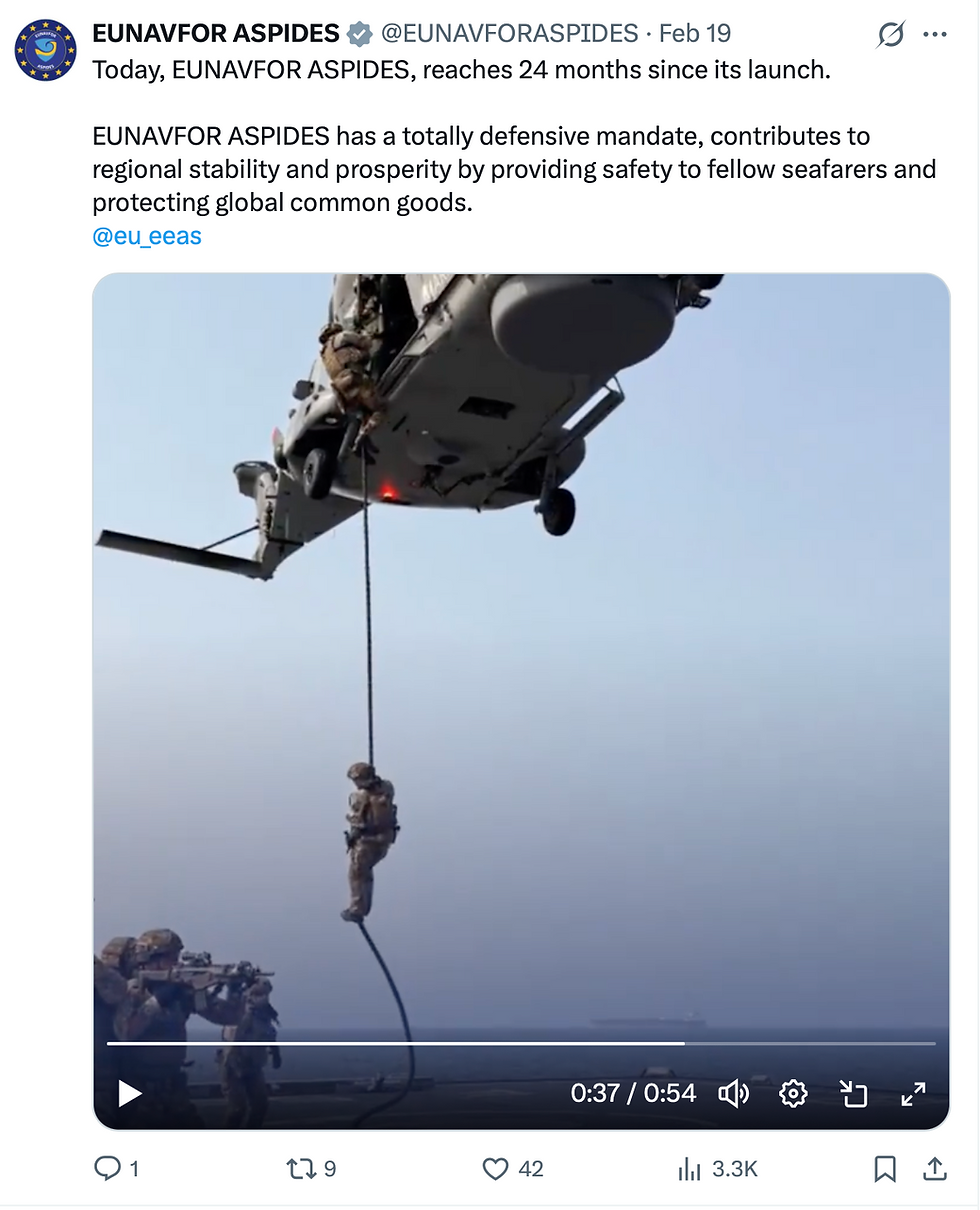
The operation was initially launched in 2024 to safeguard freedom of navigation in response to increasing threats from the Houthi against commercial vessels in the area. The mission spans over the Bab el-Mandeb Strait and the Strait of Hormuz, as well as international waters in the Red Sea, Gulf of Aden, Arabian Sea, Gulf of Oman, and Persian Gulf.
The Council has also authorized additional tasks for Operation ASPIDES, including the collection of intelligence on shadow vessels and arms trafficking. This information will be shared with organizations such as INTERPOL, EUROPOL, the IMO, and EU member states.
Impact on Maritime Traffic
Current tensions are already affecting maritime traffic, leaving operators with fewer and costly alternatives. The situation should not be interpreted as just another regional crisis, as Bridget Payne noted in comments to The Independent:
“What's different this time is the risk of escalation alongside domestic unrest, which raises the chance that the regime feels its survival is at stake,” she says. “If it reaches that point, Iran may be more willing to take options that are costly to itself, including endangering its own exports and damaging relationships with neighbours and key trading partners by disrupting traffic through the strait.”
Oil prices have skyrocketed, given that even by bypassing the Strait via pipelines, only a small percentage of the oil barrels which are usually carried through Hormuz could be rerouted. With war-risk insurance premiums drastically increasing, major maritime intelligence agencies are suggesting operators to reroute vessels, develop contingency routing and adjust their transit times.
If rerouting is not possible, Palaemon suggests extreme caution.

Don't let your vessels become statistics in the next wave of Red Sea incidents. Contact Palaemon Maritime today for a personalized pre-voyage risk assessment and learn the specific risks to your vessel, crew and cargo in these dangerous waters.
Contact us today.


Comments