Piracy prevention is entering the Engineered Era
Why improvised deterrence is giving way to engineered protection

The Era of Improved Defences
During the rise of Somali piracy, the shipping industry was forced to react quickly to a mobile, violent and determined threat. Vessels were being targeted and boarded at range, often with very little warning.
Something was needed fast to mitigate that risk.
The emergence of private armed guards provided a strong deterrent and, in many cases, an effective preventative measure. Alongside this, ships began implementing physical hardening measures to make boarding more difficult.
Much of that hardening was improvised, using materials that were readily available.
Razor wire quickly emerged as the most prominent solution.
It was cheap, widely available at ports around the world, and could be deployed cost-effectively.
For those reasons alone, it became the industry standard.
This made sense at the time. And so began the era of improvised defences.

Much of that hardening was improvised, using materials that were readily available.
The compliance-led phase
As the industry adapted to this new piracy threat, governing bodies began issuing guidance to mariners. Much of this guidance reflected what was already being done in practice, formalising behaviour and standardising expectations.
Vessels transiting high-risk areas looked visibly prepared. A clear visual deterrent was established, and a baseline level of compliance was achieved across much of the industry.
Vessels continued to be hijacked

But while compliance improved, boardings still occurred. Vessels continued to be hijacked and crews kidnapped for ransom, particularly those operating without armed guards.
The limits of improvised, compliance-led protection were becoming clearer.
Early engineering – and the limits of scale
In the years that followed, more engineered anti-piracy solutions began to appear. Purpose-designed physical barriers were developed and adopted by a number of operators.
These systems were effective. But they struggled to scale.
The upfront cost of purchasing engineered barriers was often an order of magnitude higher than razor wire, particularly when measured against how infrequently they might be used. For many operators, it was difficult to justify a large capital investment for equipment that might only be deployed once or twice a year.
Storage created another constraint. Many of these early systems were bulky, with limited consideration given to how they would be stowed onboard when not in use. As a result, even vessels that invested in engineered barriers often restricted their deployment to the highest-risk areas, with razor wire continuing to be used elsewhere.
The industry could see the next step. It just couldn’t reach it yet.
What had to change
For piracy prevention standards to evolve, any new approach needed to combine the advantages of improvised measures with the effectiveness of engineered solutions, without inheriting their drawbacks.
In practical terms, that meant something that was:
A genuinely preventative technology, not just a visible deterrent
Engineered for real boarding resistance
Quick and safe for crews to rig themselves
Compact enough to avoid long-term storage issues
Available globally, when and where needed
Cost-comparable with existing hardening measures
Until those conditions were met, widespread change was always going to be limited.
Enter the Engineered Era
Fast forward to today, and those constraints have largely fallen away.
Physical boarding protection can now be engineered properly and deployed practically, at scale and in a cost-effective way.
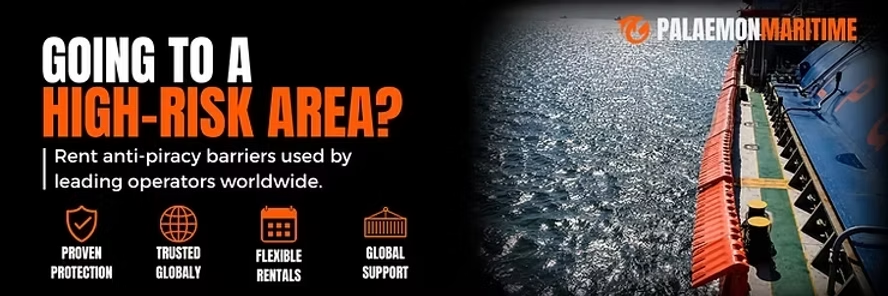
Hardware-as-a-Service models have removed the need for large upfront capital investment, allowing operators to access engineered anti-piracy barriers under an operating cost model broadly in line with what they would previously have spent on razor wire.
Rental-based deployment also removes the storage problem. Equipment can be loaded when required and landed when not, eliminating the need for permanent onboard stowage.
These changes have unlocked adoption at fleet level, not just on individual vessels.
As a result, engineered boarding protection is being adopted rapidly by oil majors and liner operators, with expectations beginning to cascade through charter chains and across the wider industry.
This shift is not being driven by regulation. It is being driven by practicality finally aligning with performance.

Hardware-as-a-Service models have removed the need for large upfront capital investment
What this means in practice
For Company Security Officers, it means improving onboard safety without compromise and making decisions that are defensible as expectations evolve.
For charterers, it means aligning with emerging oil major preferences and future-proofing commercial relationships.
For Masters, it means preparing vessels with confidence, using engineered systems rather than improvised measures.
And for crews, it means safer working conditions, reduced exposure to injury, and more meaningful protection against the risks of boarding, kidnap and ransom.
An inevitable shift
Security standards rarely change overnight. They change when long-standing constraints disappear and better practice becomes practical at scale.
That is what is happening now.
Piracy prevention is moving beyond improvised deterrence and into the Engineered Era — where physical boarding protection is designed, scalable, and aligned with modern expectations.
The shift is already underway.
Palaemon
At Palaemon, we are building for this shift — designing physical boarding protection that can be deployed globally, scaled across fleets, and accessed without the friction that limited earlier solutions.
Not as a reaction to incidents, but in response to where the industry is heading.


Comments