Somali Piracy Update: Four Attacks in Seven Days
- Palaemon Intelligence Team
- Apr 30
- 5 min read
At the beginning of this month, we published an analysis warning that the global preoccupation with the conflict in the Straight of Hormuz would create a strategic vacuum for opportunistic Somali pirates. That warning has now manifested into a localized crisis. Between April 21 and April 28, 2026, the Indian Ocean witnessed a rapid-fire series of four major Somali piracy events, including two successful hijackings involving the Honour 25 (IMO: 9243320) and another unnamed cargo vessel. This confirms that Pirate Action Groups (PAGs) are no longer just "testing the waters"; they are aggressively filling the strategic vacuum.

A Week of Escalation: The Data
The final week of April 2026 marked a significant shift in the threat landscape. While international naval assets are stretched thin, Somali pirates have launched a wave of attacks targeting diverse vessel types across a wide geographic range.
Date | Location | Incident Type | Details |
21 April, 2026 | 45NM NE of Mareeyo | Hijacking | Pirates seized control of the Palau-flagged oil tanker Honour 25 and forced it 77NM south into Somali territorial waters. |
23 April, 2026 | 83NM SE of Eyl | Suspicious approach | Two small craft with armed persons approached a cargo ship; shots were exchanged before the craft retreated. |
26 April, 2026 | 6NM NE of Garacad | Hijack | Pirates boarded and took control of a cargo vessel, redirecting it into territorial waters. |
28 April, 2028 | 500NM E of Mogadishu | Suspicious Approach | A tanker was approached by a wooden mothership and two small crafts, which turned away only upon sighting armed sentries. |
*Based on UKMTO reports
Operational Consistency : The Use of the "Mothership"

The incident reported on the 28th of April confirms that Somali PAGs still have the same modus operandi in using motherships. By operating 500 nautical miles east of Mogadishu, the PAG demonstrated an ability to strike far beyond the reach of traditional coastal patrols.
The use of a "larger wooden vessel" as a mothership remains the backbone of Somali piracy. This confirmed approach allows pirates to:
Maintain Operational Reach: They can target vessels hundreds of miles offshore where merchant crews may have a false sense of security.
Stealthy Deployment: A larger vessel is used to transport fuel, supplies, and multiple attack skiffs deep into the Indian Ocean.
Force Multiplication: Small craft can be launched from the mothership to approach a target from multiple angles, as seen in the April 28 approach where two craft closed to within 400 meters of a tanker.
Risk Analysis: A Shifting Threat Picture
The UKMTO has officially raised the alarm, confirming the critical transition in the regional security environment. The shift from general alerts to specific warnings and guidance about Pirate Action Group (PAG) activity highlights that the risk is no longer theoretical; it is operational and immediate. By urging vessels to maintain high vigilance while military forces are occupied with ongoing investigations, the authorities are effectively acknowledging a gap in immediate naval protection.
Furthermore, it signals a critical transition in the regional security environment, as the threat landscape in the Northwest Indian Ocean is no longer one-dimensional; it has evolved into a multi-dimensional crisis spanning both military confrontations and private criminal actors. While global naval forces are engaged with state-sponsored and military-grade threats in the Straight of Hormuz, private Pirate Action Groups (PAGs) are filling the void, creating a secondary front of low-tech but high-impact criminality.
"Due to the increased threat of possible PAG activity, all vessels must transit with "caution and report any suspicious activity to UKMTO while authorities investigate." - UKMTO
Our analysis of this cluster reveals three critical risk factors:
Diminished Deterrence: The hijacking of the Honour 25 near Mareeyo and the seizure near Garacad prove that pirates are successfully redirecting vessels into territorial waters before naval intervention can occur.
Increased Aggression: The exchange of fire near Eyl on April 23, as documented in UKMTO reports, shows pirates are increasingly willing to engage in kinetic confrontations to test a vessel’s resolve.
Visual Selection: In the April 28 incident, the PAG only turned away upon "sighting armed sentries". This confirms that pirates are actively scouting for visible defensive measures before committing to an attack.
Recommendations: Beyond "Caution"
While the UKMTO recommends reporting suspicious activity, "caution" alone will not stop a determined boarding party. To mitigate the current high-risk environment, Palaemon Maritime recommends a shift to active physical exclusion:
Deploy Armed Sentries: As seen in the incident 500NM east of Mogadishu, the presence of visible armed security can be the deciding factor that forces a PAG to turn away.
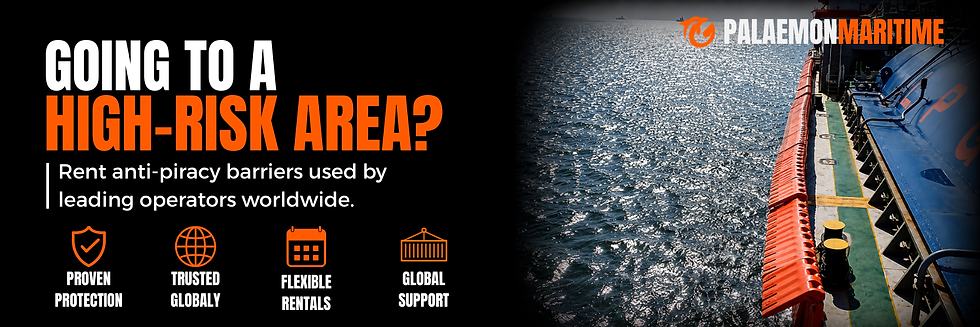
Signal "Hard Target" Status: A professional , unbeaten, barrier system provides a powerful visual signal that often prevents an approach from even starting.
Exceed BMP5 Standards: Supplement reporting protocols with hardware that removes the human element of risk and provides physical deterrence.
Maintain High Vigilance: Vessels must remain alert to any craft that could be acting as a mothership, particularly those operating far offshore.
The Bigger Picture: A Pattern of Failure
The cluster of hijackings and suspicious activity in just a span of a week exposed a harsh reality: razor wire and traditional security security measures are failing. In the two successful hijackings conventional hardening methods were clearly inadequate against determined attackers. With a 90% failure rate, razor wire often creates a false sense of security while exposing crews to additional risks during installation and removal.
Consider the operational burdens of razor wire: crews spend up to five hours removing razor wire before ship-to-ship transfers, creating extended periods of vulnerability. During these critical moments, vessels are essentially defenseless—exactly when pirates often strike.
Beyond Traditional Failures: A Proven Alternative

The maritime industry needs solutions that actually work. At Palaemon Maritime, our specialised anti-piracy barriers deliver 90% greater effectiveness than traditional razor wire systems, providing robust protection without the operational risks.
Our Hardware-as-a-Service rental model offers:
Long-term service for vessels in high-risk areas over 180 days annually
Short-term coverage for specific voyages (20-90 days)
Flexi-rental for spot market operations with on-hire/off-hire flexibility
Complete Service Integration:
Pre-voyage risk assessments analyzing vessel vulnerabilities
Professional crew training with hands-on instruction and emergency procedures
Full logistics management including customs, loading, and delivery
Ongoing voyage support with installation verification and direct communication
STOP PIRATES
Because your crew's safety cannot depend on methods that fail 90% of the time.
The Honour 25 crew learned this lesson the hard way. Don't let your crew become the next statistic.
Ready to upgrade your maritime security?
Get a free pre-voyage risk assessment and discover why our barriers have never failed to prevent unauthorised boarding.


Comments